




Overview
Ave Maria University (AMU) was founded by former Domino’s Pizza owner Tom Monaghan as a direct response to Blessed Pope John Paul II’s call for a new evangelization.
“Ave Maria’s Catholic identity is palpable in every aspect of its campus life from academics to student activities,” said Michael Dauphinais, dean of the faculty. “The faculty and students enjoy being at a university where they possess the freedom to be Catholic.”
AMU has quickly built a national reputation for its strong Catholic identity, largely because of the notoriety and devotion of its founder. What is less known is AMU’s academic quality, which is quite good.
Built from the ground up on a tract of farmland, AMU moved from Michigan to its permanent site in 2007, adjacent to the new town of Ave Maria and approximately 25 miles east of Naples, Florida. “It was the easiest place to attract students and faculty to, and I wanted to be close to Latin America,” said Monaghan, who has donated much of his wealth to the University and owns a half-interest in the town and its development, upon which AMU’s future partly depends.
AMU now has 886 undergraduate students, most of them Catholic. The decline of the real estate market in recent years has

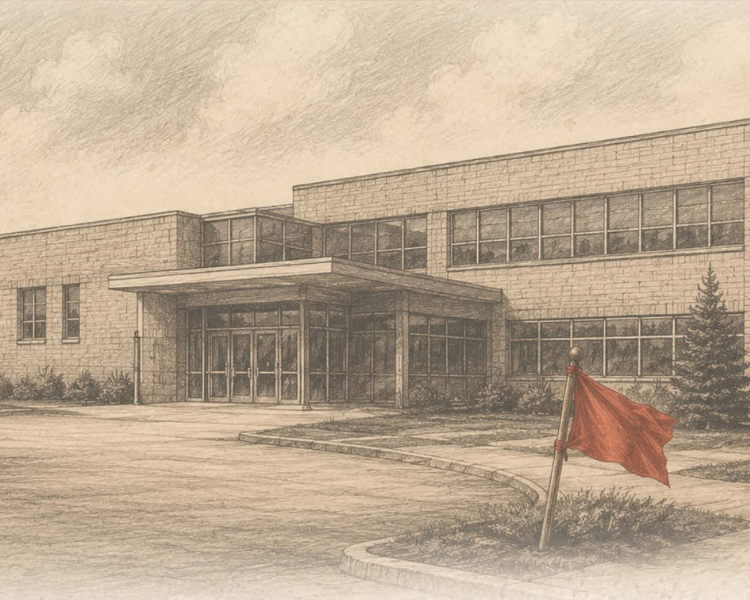
delayed Monaghan’s original plans for a much larger university and community. Nevertheless, relative to other new institutions, AMU and its surroundings have experienced dramatic growth and construction. This includes all of the Frank Lloyd Wright-inspired campus buildings, the massive Oratory, and the town’s bright-colored retail shops and condominiums. Even Oil Well Road, the primary route to AMU, expanded from a two-lane road making it easier to get to the campus.
In February 2011, AMU welcomed its second president James Towey, who had been president of St. Vincent College in Pennsylvania and also a federal government official responsible for grants to faith-based programs. With Towey the presidency assumed the typical role of chief executive, which had previously been held by Monaghan in a supervisory role over the president.
The University is governed by a 21-member board of trustees consisting of both laity and clergy, but all must be Catholic. Bishop Frank Dewane of Venice, Florida, is an ex officio board member. He officially recognized AMU as Catholic in 2011, following a period of review.
Catholicism is exhibited throughout the University’s architecture, art, and curriculum. The centrality of the Oratory and the availability of the Sacraments highlight the school’s focus. Beautiful religious art is found throughout the 400,000-volume Canizaro Library.
AMU is growing quickly and will likely see many changes in the coming years. Without a significant base of alumni, the University has gained approximately 50,000 donors since moving to Florida and initiated a Founders Club that serves as “alumni in faith”—supporters from around the country who provide for the school’s needs.
Academics
Both students and faculty speak of the academically rigorous coursework at Ave Maria. “If you’re not coming here for academics, you’ll have four years of suffering, and the teachers will have no leniency,” said graduate Daniel Montgomery. But among the students we have spoken to, they simply love the quality of their classes.
Half of the 128 undergraduate credits required for graduation must be within the core curriculum. All students take 16 core courses, including three in each of history/politics, philosophy, and theology, as well as math, literature, a foreign language, and the natural sciences. These are intensive four-credit courses, instead of the typical three-credit courses at many institutions.
Currently, the University offers 21 undergraduate majors. In addition to the more typical majors like business and the liberal arts, students can emphasize Catholic studies, biochemistry, global affairs, and managerial economics. The most popular majors are theology and biology, but these represent less than a quarter of students. Minors are available in many of the same subjects as well as catechetics, ecology and conservation biology, and family and society.
Both the philosophy and theology faculty take the Oath of Fidelity, and all theologians have the mandatum. Notably, the theology

faculty includes Theology of the Body expert Michael Waldstein and chairman Father Matthew Lamb.
Students can attend lectures integrating Catholic theology with particular disciplines as a series of panels including faculty from various departments, titled “Honors Integrated Colloquia.”
Ave Maria operates an English-speaking satellite campus in Nicaragua, 25 miles from the capital of Managua. Students can study for one semester abroad in Nicaragua or at the University’s program in Rome.
Spiritual Life
Six priests serve the campus. Several Dominican religious sisters also assist the campus and the nearby private K-12 Catholic school.
AMU offers various liturgical styles. In addition to an Extraordinary Form Mass each Sunday and twice during the week, a variety of daily and Sunday Masses are offered in Ordinary Form Latin and English, including one featuring charismatic praise and worship music. The Sacrament of Reconciliation is available four days a week.
According to Father Robert McTeigue, S.J., “The motto of the Office of Campus Ministry, ‘Christus mundo—mundus Christo’ (‘Bringing Christ to the world and the world to Christ’), epitomizes our mission of evangelization, catechesis, discipleship, fellowship, and worship. The overwhelming majority of Catholic students attend Sunday Mass and many students attend daily Masses and receive the Sacrament of Reconciliation.”
Students describe a strong spiritual life that includes various devotional groups, approximately 13 voluntary “households” of students supporting each other in prayer and service, and student activity clubs such as the Knights of Columbus, Communion and Liberation, peer ministry, and Marian consecration. Students impressively maintain perpetual Eucharistic Adoration in the University chapel as well as a daily rosary walk. Students also have joined mission trips to Ecuador and Nicaragua.
Ave Maria has an active religious vocational discernment program. There are separate men’s and women’s discernment households. These households allow young people to live, pray, and study together.
At least 20 men and as many women who have attended AMU are now discerning religious life; about a third of the University’s male graduates are in seminary discerning a vocation.
The dean of students conducts a senior exit interview with each student. The one comment heard most often is, “I came here with my parents’ faith, but am leaving here with a deeper faith of my own.”
Residential Life
With exceptions for students whose families reside in Ave Maria, it is university policy for all students to live on campus.
Residence halls are separated by gender, and the opposite gender is never allowed to visit dorm rooms. In common areas, visiting hours are until 1:00 a.m. and extended to 2:00 a.m. on Friday and Saturday.
AMU desires to give students “true freedoms.” Students must dress “with modesty and prudence,” and the student handbook offers

guidelines regarding dressing with dignity. The University sponsors discussions and classes to promote chastity and teach the Theology of the Body. Movies and television programs viewed on campus “should be in good taste and not offensive to Catholic morals and values.”
Alcohol is allowed with limitations, and there is no campus curfew. Those who violate the alcohol policy are required to participate in alcohol education seminars.
In many ways, the town of Ave Maria is somewhat insulated. As such, it’s a bit like an extended family where everyone tends to know everyone, and students and faculty often travel around campus and town by bike.
Developers plan to bring large employers and housing developments to the county, which will change the area considerably. But in the meantime, there are some inconveniences: the nearest hotel is 26 miles away, there is no gas station in town, and the nearest hospital is about 20 miles northwest of the campus. Southwest Florida International Airport in Fort Myers is approximately an hour away. Off-campus employment is limited.
Student Activities
More than 60 student clubs, organizations, ministries, outreach efforts, and households offer an abundance of activities that include athletic clubs (such as fencing, equestrian, running, ice skating, swing dance, rugby, and shark fishing) and academic clubs (such as debate, writing, film, and business).
The University’s 17 varsity teams compete in the National Association of Intercollegiate Athletics (NAIA) in baseball, basketball, cheerleading/dance, cross country, football, golf, soccer, softball, tennis, and volleyball. Students can also participate in a variety of club and intramural sports.
At least half of the student body is engaged in some form of service work. The nearby Hispanic farming community of Immokalee is

one of the poorest regions in the country and affords students numerous opportunities for service, including a food and clothing bank, soup kitchen, Christmas toy and shoe collection, Habitat for Humanity, youth ministry, and a school on wheels that teaches English to home-bound mothers.
Every Monday, students travel to Naples to pray and minister outside an abortion business. The pro-life and chastity clubs are popular, and more than 100 students attend the March for Life in Washington, D.C., each year.
The Bottom Line
AMU is a new institution that has been under intense scrutiny from both the media and the Church, largely because of Monaghan’s high profile as the multimillionaire who built and sold Domino’s Pizza. But there has also been a lot of interest in Monaghan’s grand vision for a major Catholic university that will one day rival the University of Notre Dame.
Now responsible for fulfilling a somewhat more practical vision in a tough economy, President Towey says the University has survived “the pains of childbirth,” and it has emerged a quite attractive university for students. Hoping one day for an enrollment of 5,000, the University today enjoys a close-knit community in a small campus town, where it is common to run into professors at the Smoothie shop or the supermarket. The European-style town with education, faith, and art at its center is something of an oasis.
When you take into account the unswerving promotion of Catholic values, the strong core curriculum, and the presence of an impressive and faithful faculty, Ave Maria stands as an exciting new option available to American Catholics today.
“They’ve raised something up for the glory of God, and the good of students,” says President Towey of his predecessors. “Ave Maria is a prototype of what Catholic education in the 21st century can be.”