

Overview
Located in the heart of Houston, Texas, on a 19-block campus, the University of St. Thomas (UST) has a goal of becoming no less than “one of the great Catholic universities of America.” But for decades, this university launched in 1947 by the Basilian Fathers has been something of a secret outside of the Southwest. As it becomes better known, UST’s solid Catholic liberal arts education is poised to attract a wider following.
The University has five schools—arts and sciences, business, education, nursing, and theology (offered at nearby St. Mary’s Seminary). Nearly one-third of the students on campus are enrolled in graduate programs.
Among the 32 majors are the interdisciplinary Catholic studies, theology, pastoral studies, international studies, and studio arts programs. Many minors are available, including Irish studies and creative writing. There also are many joint majors, and students have the opportunity to pursue a Western Civilization-oriented honors program.
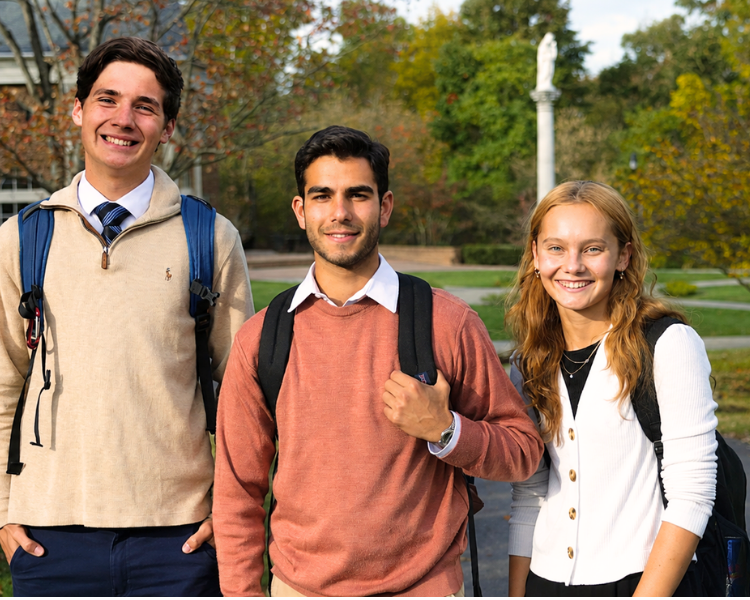
Forty-six percent of UST undergraduates are Texans, most are commuters, and 61 percent of its alumni have settled in the Houston area. But the remaining students come from 40 other states and 58 foreign countries.
Over half the students are minorities (Hispanic, African American, Asian American, and Native American), and many of these are first-generation college students. Under Title V of the Federal Elementary and Secondary Education Act, UST is identified as a Hispanic-Serving Institution, reflecting its greater than 25 percent Hispanic student population.
The University is most certainly a college on the move. In 2011, the St. Thomas Cameron School of Business achieved accreditation

through the prestigious Association to Advance Collegiate Schools of Business (AACSB International). UST also reopened its School of Nursing and is running a capital campaign to fund a new 75 million dollar Center for Science and Health Professions. The University partners with the Harris County Hospital District for a nursing preceptor program, which allows students to work and learn one-on-one with expert clinical nurses.
University regulations require the president to be a Catholic. In fact, six of the eight UST presidents have been Basilian priests. The current president is Dr. Robert Ivany, a retired Army major general with tours stretching from Vietnam to Kuwait. He previously headed the U.S. Army War College and holds a Ph.D. in history from the University of Wisconsin in Madison.
The board of trustees is primarily comprised of lay members, although a third of the members are either Basilians or Basilian appointees.
Although 36 percent of the student body is non-Catholic, the Catholic identity of UST is apparent. Ten Basilians reside on the main campus, and the Order permeates the life of the University with its “quiet orthodoxy.”
The School’s price and financial aid package for the average student are roughly equal to the average for private colleges and universities in Texas. Tuition, room, and board cost $36,290 in the 2012-2013 year.
Academics
While many schools are opting toward curriculums emphasizing vocational education, UST places emphasis on the study of theology and philosophy. In these two disciplines, 21 credits are required for graduation: nine in theology, nine in philosophy, and another three in a synthesis course that brings philosophy or theology into conversations with a student’s academic major. Even transfer students must take at least six credits in theology and in philosophy.
These requirements form the basis of the substantial core curriculum, which includes credits distributed among English, foreign languages, history, social and behavioral sciences, natural sciences, mathematics, fine arts, and oral communications. This overall core of 59 hours is unusually large among colleges that offer multiple majors.
The theology courses include two that are required for all students and set a clear tone for the curriculum: Teachings of the Catholic Church and Intro to the Sacred Scriptures. The third course is selected from several options within the field of moral theology.
The philosophy requirement is satisfied by taking three mandatory courses in a systematic sequence (Philosophy of the Human Person, Ethics, and Metaphysics) or in a historical sequence (ancient, medieval, and modern philosophy).
Most unique is the synthesis course, which is selected with the help of an academic advisor. There are a wide variety of options intended to coincide with a student’s planned major. All are taught by theology, philosophy, or Catholic Studies professors.
Incoming freshmen participate in the Freshman Symposium: Educating Leaders of Faith and Character, a program that introduces students to the University by focusing on St. Thomas’ mission to educate leaders who can think critically, communicate effectively, lead ethically, and succeed professionally.
Catholic Studies is one of the double majors available. There is also a four-year, seven-course honors program that is heavily weighted toward the heritage of the Christian West. Even the revamped Environmental Sciences and Studies Department incorporates a Catholic moral perspective.
The University also has cooperative agreements for dual-degree programs in engineering and technology with Texas A & M University, the University of Houston, and the University of Notre Dame. There are several other pre-professional programs in dentistry, law, medicine, optometry, and pharmacy.
Some departments have few or no Catholics, but faculty members are expected to respect the Catholic identity of UST. Theology

professors must be faithful to Church teaching and are required to receive the mandatum from the local bishop.
UST offers a study-abroad program with classes in England, Ireland, France, Spain, and Argentina. About 10 percent of students take advantage of these opportunities.
To encourage practical experience in the local community, UST offers a service learning program. Students can ask professors for service placements in the local community, perform service hours for a nonprofit organization, and often write a paper or otherwise reflect on their experiences.
Spiritual Life
Religious life revolves around the small, attractive stucco Chapel of St. Basil. It is at the chapel that most of the 16 weekly Masses are offered and confessions are heard Monday through Saturday. Sunday Masses are well-attended, and there are also Latin, Spanish, and French Masses and Masses for people with special needs. Three times a semester, a student group sings Gregorian chant for a traditional Extraordinary Form Mass.
Adoration and benediction are held every Monday, and adoration is also held on Wednesdays at 8 a.m.
The presence of approximately 11 priests on campus, mostly Basilian Fathers, and the Franciscan Sisters of the Eucharist is important in creating the nurturing spiritual environment that exists. There also is a nearby convent of Vietnamese Dominican Sisters, and these religious participate in campus activities and take classes.
Social service programs are offered through Campus Ministry, but the University also has a Center for Social Justice, which offers internships and other opportunities for service.
Residential Life
Only about 20 percent of UST students live on campus, which limits residential life. The coed residence features private bathrooms in student rooms. There is a second residence hall for upperclassmen, and some students live in apartments surrounding the campus.
A Basilian father is in residence. Monday evening Mass and daily night prayers are offered in the Chapel of St. Macrina.
The campus does not have a health center, although UST has a partnership with the University of Texas health services. Students use the world-famous Texas Medical Center, a vast complex of hospitals and health care facilities located a short distance from UST.
Students gravitate to the many cultural, sports, and social offerings that are available in the adjacent museum district and within a short distance from campus. These include the Museum of Fine Arts, the Houston Zoo, and several major shopping areas. The Houston Space Center is the top local tourist attraction.
Houston is a major transportation hub, and students have access to two major airports (George Bush Intercontinental and William P. Hobby), east/west Amtrak service, several major highways, and an extensive bus service. Houston relies heavily on car transportation.
As a large, diverse city with a population of about six million, Houston has a crime index rate of about double the national average. Some of this spills over onto the campus, largely as theft or pranks, but there have been some burglaries reported.
Student Activities
Sixty-nine campus groups provide students with extracurricular opportunities that include typical clubs as well as several targeted to

various ethnic groups. Among the Catholic-oriented groups are the theology club Chi Rho, a Knights of Columbus council, and a pro-life club.
Chi Rho sponsors an annual career and volunteer fair for the Archdiocese of Galveston-Houston and a “Theology at the Lab” series in which professors are invited to give talks to students in a local pub.
The University of St. Thomas Celts for Life Club participates in the Texas Rally for Life in Austin and the March for Life in Washington, D.C. Students also pray weekly at a local Planned Parenthood facility.
UST’s young athletics department joined the National Association of Intercollegiate Athletics Red River Conference in 2011. The Celts compete in women’s volleyball, men’s soccer, men’s and women’s basketball, and men’s and women’s golf. There are also nine sports clubs, ranging from coed fencing to men’s rugby, and intramural activities as well.
The monthly Summa newspaper reaches 3,000 students. The Laurels literary magazine and a new features magazine, Thoroughfare, provide additional outlets for student writing. A University committee reviews student publications.
Various dramatic and musical performances are offered by the Fine and Performing Arts Department at the campus’ Jones Theatre.
Students can volunteer at the nearby John P. McGovern Museum of Health and Medical Science. They assist with Head Start programs there and with other activities.
UST sponsors occasional recreational trips, such as rock climbing, horseback riding, and sailing. There are also several fitness classes available. The Jerabeck Activity and Athletic Center includes a large gym, racquetball courts, a weight room, a fitness room, a dance room, a swimming pool, tennis courts, a volleyball court, and an outdoor basketball court.
The Bottom Line
The University of St. Thomas is an excellent liberal arts-oriented institution. Its extensive core curriculum provides graduates with a

well-rounded education. The School continues to place a strong emphasis on its Catholic identity, which is reflected in its faithful theology and philosophy departments and by the way that Catholicism permeates the campus.
UST is unique among most of the Newman Guide colleges with its racial diversity and small portion of students living on campus. Students reluctant to attend a small college but wanting a solid Catholic education may be especially attracted to UST.
Hewing to its 65-year-old tradition—and building on it—the University of St. Thomas is poised for growth. Local, first-generation college students from the area will continue to benefit, but so will those from around the country looking for a quality Catholic education at an urban university.